

How to Choose Fonts for Arabic, Urdu, Hindi, and Bengali PDFs
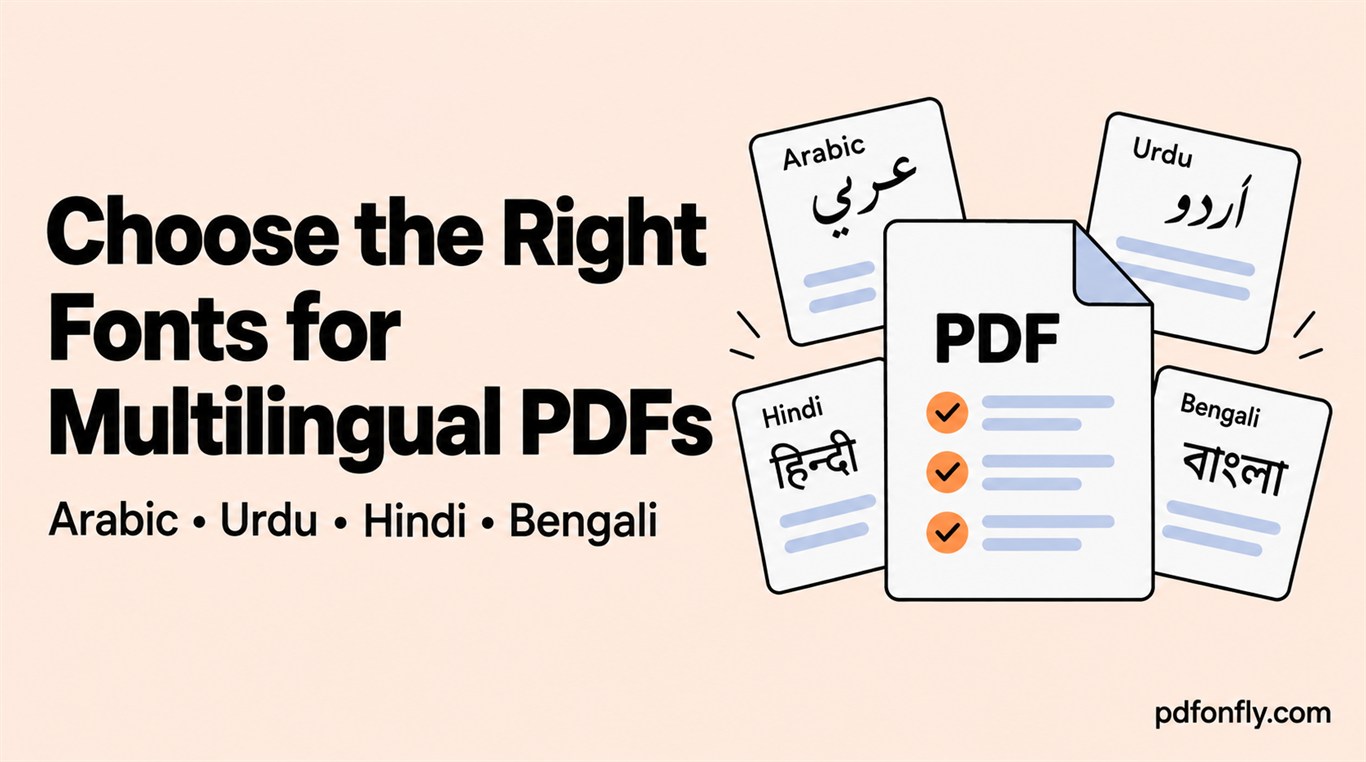
There is no single “best” font for every multilingual PDF. The correct font is the one that covers your characters, shapes them correctly in the converter, produces acceptable line spacing, and preserves usable text in the final file.
1. Test glyph coverage
Create a short sample using the exact script features in your document:
- Arabic: joined letters, diacritics, punctuation, Arabic and Western numerals.
- Urdu: joined text, Nastaliq or Naskh expectations, dates, and English names.
- Hindi: matras, reordering marks, and conjuncts such as क्ष, त्र, and ज्ञ.
- Bengali: vowel signs, conjuncts, reph forms, and punctuation.
Missing boxes are an obvious failure, but substituted glyphs and misplaced marks are equally important.
2. Test regular and bold separately
Bold may be a separate font resource with different coverage. Make the same native-script phrase regular and bold. If bold text changes family, loses marks, or becomes clipped, use a family with a complete weight set or avoid that weight.
3. Check line metrics and page breaks
Some Urdu and Arabic fonts need more vertical space. Devanagari and Bengali marks can extend above or below the typical Latin line box. Inspect crowded lines, clipped marks, headings, and the last line on each page.
4. Test mixed scripts
Add English, dates, currency, email addresses, and product names. For Arabic and Urdu, confirm paragraph direction and punctuation. For Hindi and Bengali, compare the Latin and native-script baselines.
5. Verify text behavior in the PDF
After using the multilingual text-to-PDF tool, copy a native sentence and search for a word from it. A font that looks good but produces unusable character mapping has not passed the test.
A repeatable acceptance checklist
Approve a font only when:
- All required characters render without fallback boxes.
- Shaping and mark placement match the source.
- Regular and bold styles both work.
- Mixed English and numbers remain readable.
- No marks are clipped at normal line spacing.
- The resulting text can be copied and searched.
Record the exact font family, weight, sample text, converter version, and test date. That evidence is more reliable than a generic list of font names.